STITCH LINES...... Ramblings on life as a quilter, stitcher, traveler, photographer, gardener and lover of books, cats and fine chocolate....
Showing posts with label Wildflowers. Show all posts

Wednesday, July 17, 2013

Wildflower Wednesday

It's time for Wildflower Wednesday again.. the week has flown by, but I have found a bit of time to go looking once again for some interesting wildflowers to share with you. The first one this week is one that I'm not totally sure I have identified correctly. I found it at my friend Donna's cottage, growing on the rocky shore/beach at Maquapit Lake. I think it is Wood Anemone, it seems to fit the description perfectly except for the flowering time, which is earlier in the spring - May/June around these parts. This year everything seems earlier than usual, not later, probably because of so much rain this spring. So perhaps I am wrong. If anyone out there can tell me for sure what this flower is, please leave a comment. I will continue on the assumption that it is Wood Anemone (Anemone quinquefolia), a member of the buttercup family. My trusty Audubon Field Guide to North American Wildflowers describes it perfectly: "A low, delicate plant with a whorl of 3 stalked deeply cut leaves and a solitary stalked white flower. Flowers 1" wide, sepals 4-9, white, petal-like, pistils and stamens numerous." Looks right, no? "Since anemones are usually slender-stalked and tremble in the breeze, they have been called Wind Flowers".


This next one I am sure of.. it's Black-eyed Susan (Rudbeckia hirta), sometimes called Brown-eyed Susan too... It grows throughout North America in fields, prairies, open woods and along roadsides. I'm sure it is familiar to most anyone who pays attention to flowers at all... Its golden-yellow daisy-like flower heads with brown central cones and rough hairy stems make it easy to identify. It is a biennial, forming a rosette of leaves the first year and flowers the second year.


I have featured this next flower before, but I love it so and it is getting harder and harder to find. This year I found it in a different location and the coloring is a bit different- so here we go again with the Canada Lily (Lilium canadense) also known as Meadow Lily or Wild Yellow Lily. Each summer I drive downriver to the Maugerville-Sheffield area to seek out this flower. I was feeling sorry for myself that I wouldn't get the chance to do that this year as I've been so busy lately and we leave for our trip tomorrow. But lo and behold, last week when I was upriver and exploring with "Cousin Debby" - what do we find but several Canada Lilies! Look at the coloring- it is darker (more orange-y) and much more
spotted than the ones I have found other years (you can see them here and here.) I suppose different soil would have an effect and also this plant was not out in the open, but in more of a wooded area - perhaps that would be a factor too. Anyway I could not pass by without taking its photo.. just for you! Enjoy!
That's all for today. What wildflowers have you discovered lately?

Peace,
Linda

"Each flower is a soul opening out to nature." ~ Gerald DeNerval

Wednesday, July 10, 2013

Wildflower Wednesday

I had to make a quick trip to Grand Falls a few days ago. The flowers along the highway were so beautiful... I could have stopped a dozen time to take photos. But you know me - any excuse to stop for some photos... lol

The first wildflower this week is a new one to me. From a distance I just assumed the bright yellow was buttercups. However once I got close, I realized this was something different. I had never seen this flower before and had to come home to my trusted wildflower book to identify it. It's called Birdsfoot Trefoil and is a member of the pea family. It's a low growing plant with clover-like leaves and bright yellow pea-like flowers in a flat-topped circular cluster. It will have slender seed pods later on. This plant was introduced from Europe apparently, and the pod arrangement suggests a bird's foot, hence the common name. It's Latin name is Lotus corniculatus. (I just know you wanted to know that!  wink)

I'm sure you are familiar with my next choice- Cow Vetch or Blue Vetch (Vicia cracca). It too is a member of the Pea family. It is a common wildflower (weed?) here in the Maritimes, found in fields and along roadsides. It's a climbing plant, with twining tendrils at the end of each leafstalk. The leaves are a gray-green and the flowers are long one-sided spikes of pea-like tubular blue/purple flowers which are directed downward on a long stem. It is so pretty along roadsides especially where it grows in great mounds or drifts, adding that wonderful blue-purple color. When Buttercups or Birdsfoot Trefoil are nearby, I love the color combo of purple, yellow and green - I think it would make a great color combination for a quilt, what do you think?
I don't often do two posts in one day. If you missed my earlier post today on NYC, keep reading below...


Peace,
Linda

"Where flowers bloom, so does hope." ~ Lady Bird Johnson,  Public Roads: Where Flowers Bloom

Wednesday, June 26, 2013

Wildflower Wednesday


Last week when I had several visits to "my" lupin patch, I also found these beautiful wild roses. Aren't they gorgeous? I wish you could smell them.. the scent was heavenly...  Naturally I took some photos of them as well, for this week (always trying to  think ahead!!) My time is very limited today so I'm not going to gab...  I know you just want to enjoy these few photos. Do you have any wild roses blooming where you live?


Peace,
Linda

"As you walk down the fairway of life you must smell the roses, for you only get to play one round." ~ Ben Hogan


Saturday, June 22, 2013

More Lupins...

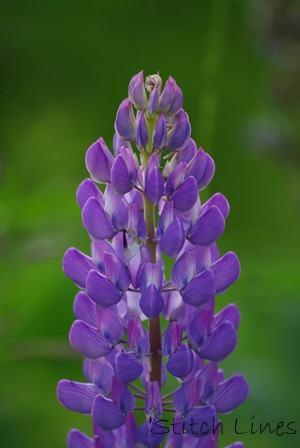
Okay, I admit it! I'm a Lupin-lover. I just have to share a few more of my 2013 Lupin photos with you... When I commented on my friend Pam's blog after she posted some lupin photos earlier this week, I told her I'd be visiting my "favourite patch" for photos this week and she said "Oh take lots of closeups". So Pam - these are for you...

First of all, some lupin "babies"...


This shot at the right shows you what the leaves of the lupin look like - these are known as palmate compound leaves. "Palmate" refers to 3 or more divisions or lobes, looking like the outstretched fingers of a hand.


I love the way the color fades as you go up the cluster on the bloom to the left... God's paintbrush is amazing, isn't it?


I think these immature blooms are just as interesting as those which are fully open, don't you?


There were many bees and insects buzzing about this lupin patch.


Although this little buzzy bee at left is not in perfect focus, this photo makes me smile. I think I would have to title it "Incoming"....


Busy busy buzzy bees...


Such perfection.. every little flower in the upright cluster so perfectly placed...so perfectly colored.... amazing!!
 
Lorinda commented on my last post about the vivid color - just want you to know, I do NOT alter or enhance my photos. This is just what I saw and the photos are just as I took them, other than a few are cropped a bit...


 Just as I was ready to leave, having taken a good number of photos, the sun came out..... Well, who could resist some back-lit shots?  So to finish off, here are three of my favourite backlit photos... the sun just seemed to make the blossoms glow...


I hope you've enjoyed our foray into the Lupin patch...
Do lupins grow where you live?
What are your favourite wildflowers of early summer?

Peace,
Linda

The Flowers

All the names I know from nurse:
Gardener's Garters, Shepherd's Purse,
Bachelor's Buttons, Lady's Smock,
And the Lady Hollyhock.

Fairy places, fairy things,
Fairy woods where the wild bee wings,
Tiny trees for tiny dames-
These must all be fairy names!

Tiny woods below whose boughs
Shady fairies weave a house;
Tiny treetops, rose or thyme,
Where the braver fairies climb!

Fair are grown-up people's trees,
But the fairest woods are these;
Where, if I were not so tall
I should live for good and all.

~ Robert Louis Stevenson

Thursday, June 20, 2013

Wildflower Wednesday... on Thursday!

Can you believe it? I forgot Wildflower Wednesday! Well, no that's not quite true. I just sort of  "lost" a day. Hubby was away for a few days.. I was busy.. and I forgot yesterday was Wednesday!! They say that happens when you are on vacation or retired.. you lose track of the days... I guess that's what happened. Now that the normal schedule with meetings, weekly Choir practice, etc. is done for the summer and the calendar doesn't have much written on it, I sometimes lose track of the days.. Anyway, enough excuses.
Since I have very recently spent a good deal of time in the lupin patch, I'm going ahead with Wildflower Wednesday anyway, and you guessed it- the feature flower is lupins. You know I LOVE lupins, I have written about them more than once - here, here and here if you care to go back and look at previous posts and photos..  Since I'm so late with this post, I won't bore you with much more yakkety yakk... I'll just show you a few of my favourite lupin photos for this year. (Would you believe I took 213 shots within about 45 minutes?! Don't worry I won't bore you with them all.)

Lupins come in a  variety of colors - blue


 pink

purple


yellow and peach


and deep red. Although this one looks quite "pinky", it is actually a deep rosy red. Striking!


Some are pale and soft in color, most are deep and vibrant.


Some are just one color while others are bi-color.

 Regardless of their color, all are beautiful (just like people!) I have a favourite "patch" that I visit every year, not far from where I live. This time while there,  I was serenaded by a beautiful sparrow- I don't really "know" my sparrows but I figure this one had to be a Song Sparrow as his song was so sweet. His series of musical notes was charming, but he wouldn't let me get too close for a photo..  guess he was shy!

I am linking to Mosiac Monday at Little Red House. Drop by there for a look at more wonderful mosaics.

Peace,
Linda

"Tis my faith that every flower
Enjoys the air it breathes!"
~ William Wordsworth


Wednesday, June 5, 2013

Wildflower Wednesday


It's Wildflower Wednesday again and I have more "finds" to share with you, from a walk last Friday. Some weeks I know I will struggle to find something new to show but not this week!
First- one of my favourite late spring bloomers - Rhodora (Rhododendron canadense). I have heard this referred to as "wild rhododendron" - not sure if this is accurate, but it makes sense to me. It is part of the Heath family (Ericaceae) which also includes the ornamental Azaleas and Rhododendrons, and Blueberry, Huckleberry and Cranberry shrubs. This deciduous shrub usually reaches a height of between 2 and 3 feet. It blooms in this area in late May and early June, often in boggy areas and ditches. The showy flowers are a purpley pink and where there are a number of plants close together, they make quite a spectacular display when in full bloom. There are

a number of them in an area not far from my home and I always watch for their blooms at this time of year. Do you know this shrub/plant by another name? A friend who was with me when I photographed these told me he knew these as "June flowers" when he was younger. (I wonder if that was because they closely follow the blooming of what we call "Mayflowers"? (proper name Trailing Arbutus . I had hoped to find Mayflowers in bloom on this walk, but was too late. I'll go looking earlier next year!!) No doubt if you live in the Maritimes, you have seen this plant as it is fairly common in this area.


The next plant I found in flower was just a few feet from the Rhodora and it is one you likely recognize. It is the wild Blueberry plant, also a member of the Heath family. The blossoms are quite small - 1/4" - 1/2" and are white and urn-shaped, usually in clusters. Of course in several months these bushes will be hanging with delicious deep blue/purple blueberries, which are a favourite in this house for pies, muffins, crisps and blueberry shortcake! Yummmm. I can almost taste them now!! I have included a photo from last summer of ripe blueberries - just so your mouth can water too! lol


I am not 100% sure about my identification of this next one, but I think it is Sheep Laurel.  If any of my readers can identify it for sure, please leave a comment! It is also a member of the Heath family. It fits the description in my trusty Wildflower guide - "an evergreen shrub with small deep pink saucer-shaped flowers in dense clusters around the stem. Flowers 1/3"-1/2" wide, 5 petals and 10 stamens." Edit- My friend Pamela has confirmed this is Sheep Laurel. Also known as Lambkill, this small shrub is poisonous to livestock.


Lastly I leave you with some Lady's Slippers. I was so excited to find many on my walk, and not too far from where I live either! Woohooo! You can be sure I'll be visiting this area again next spring to see more. I hadn't seen Lady's Slippers in many years, until my friend Gail told me last spring there were some in the woods by her cottage. I braved the voracious bugs to photograph them, but it was SO worth it!! And now I find them within a few miles of my home! The bugs there were once again out for blood, so these were snapped pretty quickly.. nothing fancy schmancy - just "record shots"... but aren't they beautiful? They belong to the Orchid family, and are one of the largest native orchids. You can read more about this beautiful wildflower on last year's post here, in particular the symbiotic relationship they have with a certain fungus, and why you should not pick them or try to transplant them to your garden at home. The Pink Lady's Slipper blooms can vary from a deep pink to a paler pink to a white - I found all three!!


That's it for this week. Who knows what treasures I might find for our next Wildflower Wednesday... Stay tuned....

Peace,
Linda

"In all things of nature, there is something of the marvelous." ~ Aristotle

Wednesday, May 29, 2013

Wildflower Wednesday

I think it's time to start some Wildflower Wednesday posts again. I know I won't have one every week, but will do my best to bring you something interesting as often as I can.
It's funny how things don't always turn out the way you think they will. I had been chatting back and forth with blogger friend Pamela of Playingwithmycamera - we live about 20 miles apart and have similar interests. Anyway we have become friends through blogging and I was telling her that I was sorry to not have had the chance to get any photos of my apple blossoms due to the many days of rain. The blossoms on my trees are totally done, past, finito. And she replied that the trees on the Ridge where she lives were just coming into bloom! (Lucky me!) So we planned a get-together for today for a quick photo shoot in the orchard. We didn't know what other treasures we were going to find! So, you're going to have to wait till tomorrow to see the apple blossoms, because I'm going to share with you our "other finds" since they fit the Wildflower Wednesday meme. After all this IS Wednesday...

We drove down to the bottom section of the orchard since the owner told us that's where the best blooms were. On the other side of the road is mixed forest and both of us, cameras in hand, meandered over there for a "look-see". We quickly spotted some purple trilliums (trillium erectum). The more we looked the more we saw, but all were a bit past their best - definitely on the wane. I was (mistakenly) referring to them as red trilliums, but the red trillium (trillium sessile, aka Toadshade) has a stalkless flower which appears directly above the three whorled leaves. (Thank you, Audobon Field Guide to North American Wildfowers!!) So this is for sure "purple" trillium even though it looks more red than purple!! (Clear as mud, right?) We did not find any white or painted trilliums.. only the purple.

Next we spied some purple violets, our provincial flower, (see them in my header photo) and close by, yellow violets. I haven't seen yellow violets since I was a child! Yes that's many, many years ago....  The yellow violets are a bit smaller than the purple and seemed to have only one blossom per plant. When I consulted my wildflower guide at home, I learned there is a "smooth" yellow violet and also a "downy" yellow violet which is described as a "softly hairy plant with leaves and yellow flowers on the same stalk. Flowers are ~ 3/4" with 5 petals, the lower three with dark purple veins, the two lateral ones bearded. Heart-shaped scallop-toothed leaves." So I think I'm correct in identifying this as a downy yellow violet ( viola pubescens). Everything fits except I didn't notice that it was very hairy... But then I didn't get really up close and personal. By this time the mosquitoes had discovered us... and I have the bites to prove it..

There were some lovely small clumps of the purple violet in the dappled shade but also this paler purple one which was more in the sun. At first I thought it was the same thing - just bleached by the sun - but upon checking with Mr. Audobon (I LOVE this guide) I see that it is a different violet altogether. It is the Dog Violet (Viola conspersa) with paler bluish-violet petals, and leaves and flowers on the same stalk, like the yellow one was. (I am learning to pay attention to these small details. which makes ID'ing  a plant so much easier!)

Next we spied a Jack-in-the-Pulpit! And then another. And another. Look - we even found twins! Maybe this is Jack and Jill? I wrote at some length about Jack-in-the-Pulpit here several years ago, so I'll spare you now. But it was fun to find them. Their other fairly common name "Indian Turnip" likely results from the fact that American Indians gathered their fleshy taproots as a vegetable. (I don't suggest you try eating it though- it is poisonous due to the calcium oxalate crystals it contains.)


 Our last find before we turned our attention back to the apple orchard was this plant - it had both of us baffled. The leaves on it looked somewhat like the leaves of Astilbe, but the flower didn't. So again- I turned to my trusty wildflower guide when home and figured out that this plant is Red Baneberry (Actaea rubra)  "A bushy plant with large highly divided leaves and a short thick rounded cluster of small white flowers. When in flower the clustered stamens give this plant a feathery appearance." This plant is of the Buttercup family and its red fruit is poisonous.

So there you have it. Our first Wildflower Wednesday for Summer 2013. I hope to find many more wildflower treasures to share with you. Who knows- perhaps Pam and I will team up again soon and see what we can find... What do you think Pam? I hope you'll stop by Pam's blog here for her "take" on today's adventure.

Next up .. APPLE BLOSSOMS!

Peace,
Linda

"For myself I hold no preferences among flowers. so long as they are wild, free, spontaneous..."
~ Edward Abbey 

Wednesday, August 22, 2012

Wildflower Wednesday

As the summer wanes and we have not had any appreciable amount of rain in weeks, it's getting harder to find wildflowers worthy of this weekly post. Perhaps it's just that I have not had time the last few weeks to really "go looking".. but my looking this afternoon didn't turn up much. So what you're seeing today are just common ordinary "wildfower weeds"... nothing too exotic. My quest this afternoon  took me up the Old Springhill Road close to where I live; it's a rural road with a wonderful view over the Saint John River, looking upriver at what locals call "The Islands" - that being Sugar Island, Eqpahak Island, Hartt's Island, Big and Little Chokey Islands and Parsnip Island. I loved the clouds - so puffy and cotton candy-like. I just thought you might like to see the "setting" for today's flower photos.


As I was snapping away, I heard the distinctive dee-dee-dee of a killdeer, a member of the plover family, common on farmland. It didn't take me long to spot him with his black breastbands and his noisy call. He kept an eye on me as I walked along the pasture fence, seeing what I could find for wildflowers.

So what did I find today? Clockwise, from lower left: Goldenrod, a very common plant in late summer fields and ditches. Did you know it belongs to the sunflower family? Historically it has been used topically for wound healing and as a diuretic, and is still used today for natural dyeing of wool.  Queen Anne's Lace is not just a member of the carrot (and also parsley) family, it is the parent of our garden carrot.
No doubt this is why it is sometimes also known as "wild carrot". Queen Anne's Lace tolerates dry conditions very well which explains why it is still so abundant this year. Apparently it's name refers to Queen Anne of England who reigned during the early 1700's and was reputed to be an expert lace-maker.  Purple Loosestrife which I have already written about here. Nasty plant, but I still think it's beautiful.. (guess I'm a sucker for purple... )  and lastly Cow Parsnip which is part of the parsley family. Cow parsnip looks like the big sister of Queen Anne's Lace, having a similar shaped (but considerably larger) white flowerhead. Cow Parsnip is often confused with Giant Hogweed and also Water Hemlock. The sap of Giant Hogweed on your skin can cause severe inflammation, and Water Hemlock is very toxic if ingested, so it is wise to know the differences between them. You can read an excellent comparison here. 

So there you go- common ordinary plants this week, but as I've said before, there is beauty in all flowers. You don't have to be an orchid!!

Peace,
Linda

"If we had a keen vision of all that is ordinary in life, it would be like hearing the grass grow or the squirrel's heart beat, and we should die of that roar which is the other side of silence." ~  George Eliot
Related Posts Plugin for WordPress, Blogger...